Willis: A Chicago Architectural Tour Guide

I was recently in Chicago for DynamicsCon, a top-tier community event for users and implementers of Microsoft’s Dynamics platform–Like Me!

The conference was an excellent chance to catch-up with old friends, make new ones, and learn about the latest happenings in the world of Dynamics (If you’re curious, there are a lot of happenings).

DynamicsCon was also an opportunity to learn about Chicago.

I took in a Cubs game at Wrigley with some friends.

(Justin Turner hit a walk-off RBI for the win over the Marlins)


I also dropped in to train jiu jitsu at a local place.

(Serafin Jiu Jitsu is the most beautiful gym I’ve ever visited)

My Uber driver suggested the best way to learn about Chicago is to take an architecture boat tour–boats ferry you around the Chicago river and they tell you about the buildings. I didn’t have time for a boat tour, but his recommendation primed me to think about the architecture and design of the Chicago skyline. As I walked around Chicago, I snapped pictures of buildings that interested me.

Problem: I didn’t have an architectural tour guide to tell me about what I was seeing.
Solution: I built one.


–INTRODUCING–
Willis: A Chicago Architectural Tour Guide

Sears Tower will ALWAYS be Sears Tower to me, but I named this bot Willis because it seemed like an appropriate cousin to Watson. Simply upload a photo of your Chicago structure and Willis will tell you a bit about what your looking at and how it came to be.

An advantage over an architectural boat tour: Willis can also go on land.

TRY WILLIS HERE

I’ve written other posts on how to create a custom GPT. If you are interested, these are Willis’ configurations:


Without further ado…

A Chicago Architectural Tour, Guided By Willis

Pictures by me (All Text by Willis):

Alright! You’ve captured some amazing shots of the Merchandise Mart—or as us locals call it, “The Mart.”

🏢 Name: The Merchandise Mart
📍 Location: 222 Merchandise Mart Plaza, Chicago, IL 60654
🗓️ Year Built: 1930, during the era of Art Deco’s peak style (think Al Capone and the start of the Great Depression!)
🎨 Notable Feature: The building’s imposing size—it covers over 4 million square feet—earned it the title of the world’s largest building when it opened. That’s like 22 football fields of floorspace!
🏆 Historical Fact: Originally owned by Marshall Field & Co., it was later bought by the Kennedy family in 1945. The Mart also played host to radio station studios in the 1930s and, more recently, has become a major hub for design showrooms and tech startups.

Fun tidbit—when the Chicago Bears last won the Super Bowl in 1985, The Mart was already well-established as a local icon!

The building overlooks the Chicago River and is known for its striking setbacks and vertical emphasis—a classic example of Art Deco style.


Continue reading →
On Travel

Last summer, the ever-provocative Agnes Collard upset a lot of people by claiming travel might not be all it’s cracked up to be.

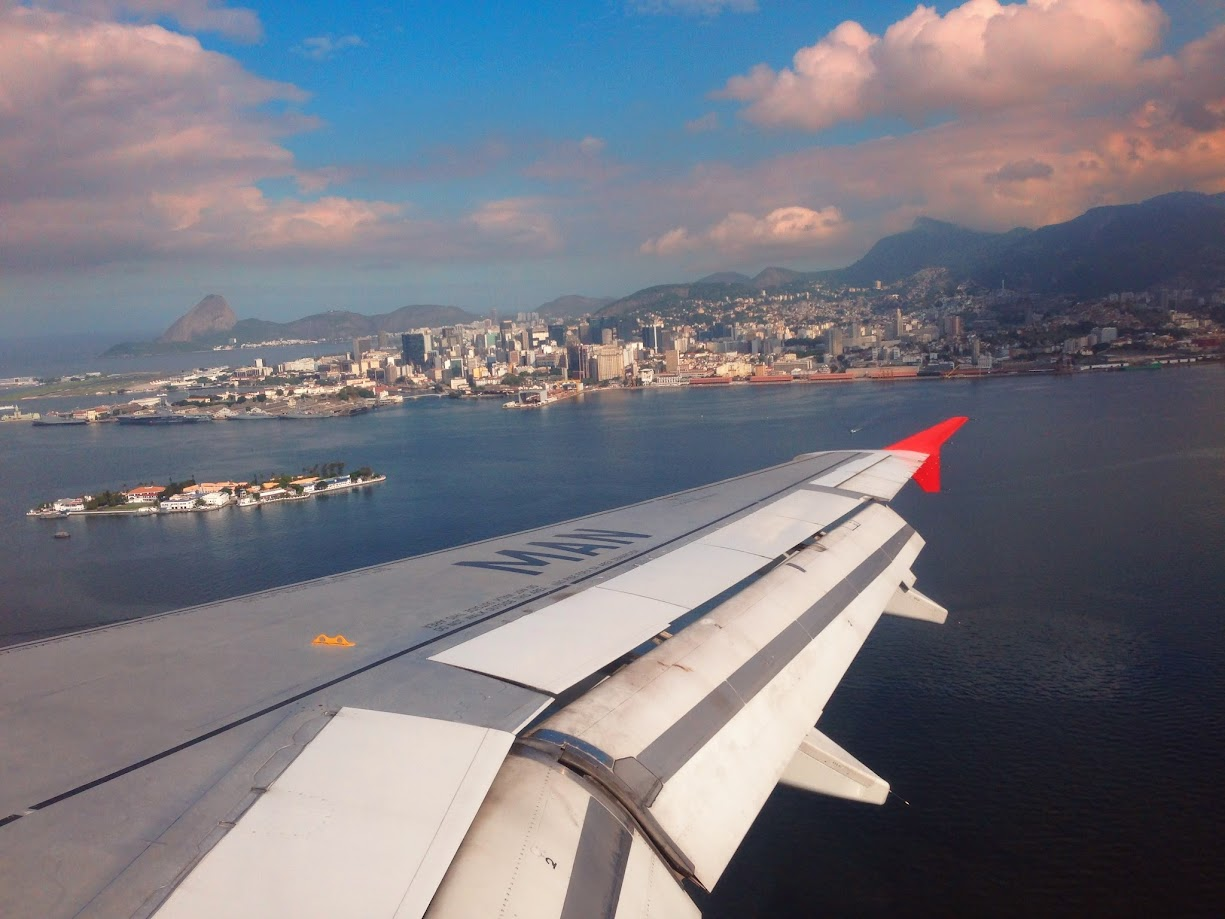
Landing approach at Santos Dumont Airport

She has a point. Travel isn’t an elevated form of entertainment. It’s not inherently more noble than watching TV, or reading a book, or consuming Twitter, or any of the multitude of other ways we explore and make sense of the world.

But she takes her claim too far when says travel doesn’t change us. “The single most important fact about tourism is this: we already know what we will be like when we return,” Collard writes in her essay. “Travel is a boomerang. It drops you right where you started.”

But ask any friend returning from a trip: “What surprised you? How was the place different from what you expected?” They’ll notice things! 

That’s change!

Asking about surprise is a Paul Graham tip for talking with people about their travels. “This is an extremely useful question,” he notes. “You can ask it of the most unobservant people, and it will extract information they didn’t even know they were recording. Surprises are things that you not only didn’t know, but that contradict things you thought you knew.”

Of course, it’s all a matter of degree. Some travels are more surprising than others. Some travelers are more capable of surprise – we might call them more curious travelers.

So travel is an opportunity to explore and make sense of the world, if you want it to be.  It seems curious travelers get more out of their trips. Given the option, how can you lean into becoming a more curious traveler?


Before you Travel

Before you travel, study up on the place you will visit: Look at maps, read histories, consume the culture. Watch movies and make music playlists related to your journey.

You can do this for any place, whether or not you travel there, but preparing for a trip is a special way to focus your attention – like a midterm creating a really good excuse to actually open and read the textbook.

Most people can only spend a limited time in a foreign place. Extended preparation is an opportunity to expand the time that the trip can nurture your curiosities. It also gives you a running start when you finally land in your destination. During your trip, you can see what still surprises you about a place after studying it. This is interesting! What still surprises you informs what you can gather about a place through book learning versus experiential learning. 

While you Travel

While you travel, it helps to have some general questions about the place you are trying to answer, then adjusting your hypotheses as you compare them with experiences from your trip.

“Do they have a good breakfast? Why or why not?”
“Are the sidewalks good? How come?”
“Why is this town here and not somewhere else? Why did it expand in these ways but not those?”

You’ll notice trying to answer these questions leads to other questions, like zooming in with a microscope. 

Also, you’ll notice that the more you travel, the more data points you’ll have to compare your experiences of one place with others. There are increasing returns to travel as your vocabulary of travel experiences grows more and more.

After you Travel

Write something about your trip. Writing is a good way to organize your thoughts and ideas about a place. It makes it easy to share those ideas with others.

Not sure what to write about?
“What surprised you?” Start there😊


Travel Influencers

Two curious travelers who have very much influenced my thoughts on travel:

Tyler Cowen has high-quality travel prep, asks great questions, and writes up his experiences. Tyler hasn’t traveled the whole world, but if you’re planning a trip somewhere chances are he’s familiar with the place. Searching Marginal Revolution for your travel destination is a great, non-commercial start to discovering a place. Before traveling, Tyler often creates a bleg post asking readers about a city. The comments sections on these are full of specialized advice from around the world. 

Chris Arnade is also a travel writer I enjoy. I think it’s fair to summarize his travel approach as 1) Go places. 2) Walk around a lot. He shares his travel photos and notes at his aptly names Substack, Chris Arnade Walks the World.

AI Travel

I built a custom GPT to help curious travelers get started. It’s designed to offer local cultural recommendations when preparing for a trip, as well as suggest open questions a traveler might keep in their mind while visiting a place.

It’s still a work in progress, but if you’re planning a trip in the near future, I’d love it if you give my chatbot a try.