
At the beginning of the year, my sister asked our family if we’d like to make a 5-person marathon team. Each person would run one-leg of a five-leg course that stretched 26 miles in total. My sister is a trail runner. The rest of us…not so much.
My sister has run marathons and ultramarathons. She’s even written essays about running.
My brother-in-law, her husband, was in a triathlon club when they met. At their wedding, he said: “I realize I don’t have to pace her, I just have to crew for her.” A pacer runs alongside a runner during subsections of an ultramarathon, while a crew person cheers for the runner as they pass aide stations and makes sure they have snacks, making this probably the most romantic sentence about running I’ve ever heard.
My brother and my uncle both served in the Marine Corps, which is basically a professional running club. And though both are out of the service now, they say “Once a Marine, always a Marine“, which is good because at 77 my uncle was one of the oldest runners on any of the marathon teams.
So when I say the rest of us aren’t really runners…I guess I just mean me.
Anyways, in August we ran the Point Mariah Trail Marathon:
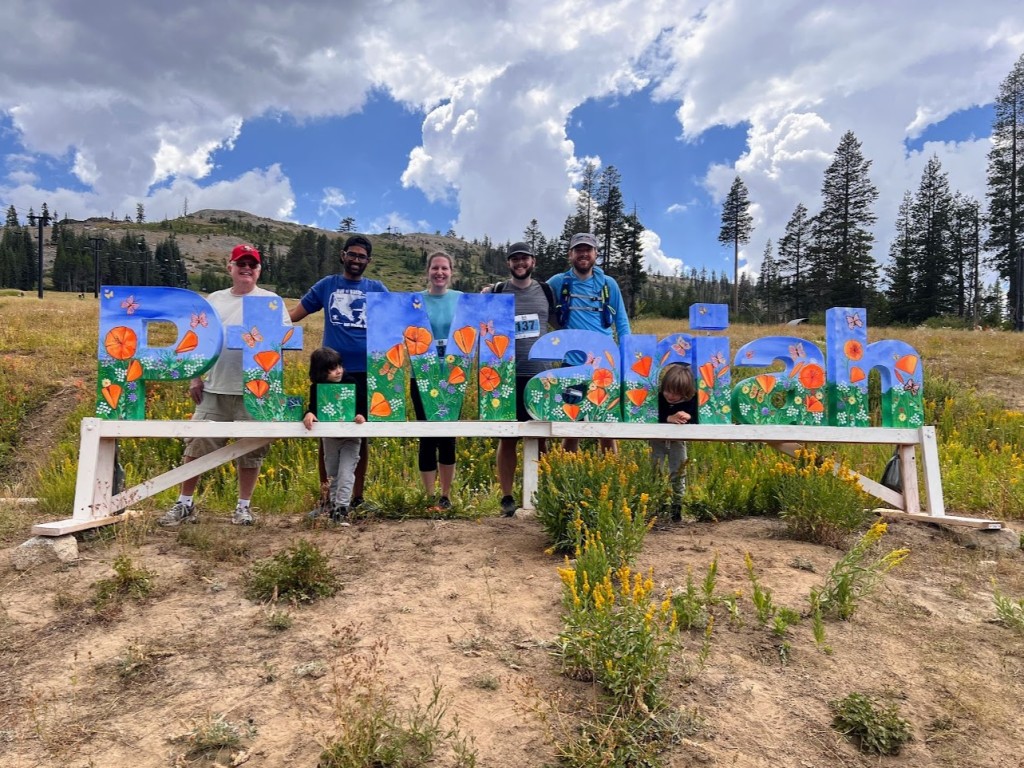
Our running team, plus my dad, Calvin and Lawrence
(at picture time, my uncle had already run off somewhere else)
While I trained to run (editor’s note: one-fifth of) a marathon, I realized almost everything I was taught about running in high school was wrong. This seems odd. We had a class called physical education (PE). PE was a mandatory part of our school curriculum—an education in physical activities like running.
Those PE classes had the educational substance of a biology class run by a teacher starting: “Welcome everyone, now before we begin it’s important everyone understand the earth is only 5,000 years old.” Though one might anticipate this sort of education if someone named “Coach” standing in front of a class.
I digress.
In my (editor’s note: again, very limited) runner training experience, I’ve found running to be more pleasant and fulfilling than I had remembered from PE. Perhaps this is because of the lies.
This is my attempt to correct the record:
4 Lies I Was Told in PE:
1. No Walking
This was a rule in my PE class. We’d line up to run the mile and the PE coach would bark: “NO WALKING!” at anyone whose jog around the track slowed to an amble.
It turns out, this isn’t a rule. There are actually very few rules when it comes to running. And better yet: as an adult you can make up any rules you want.
My friend Minnow Park shares his two rules for running:
Rule No. 1: don’t get hurt.
Rule No. 2: for most of your training, keep your heart rate between 140-160 bpm (or a pace where you can hold a conversation while running).
Sometimes, to keep your heart rate in the right zone, you need to walk. That’s fine.
Just keep going.
In fact, one of the most popular beginning runner training methods (and the one I used) involves alternating run/walk intervals. It works!
2. Stretch to Warm Up
My PE classes always started with students standing in rows and columns, bending to touch our toes, then sitting like butterflies trying to touch our knees to the ground. These are examples of static stretching warm-ups. It turns out: stretching is not a great warm-up for running.
What is a good warm-up? WALKING! (see section 1).
Walking for 5 minutes is a great running warm-up. Equally important is walking for 5 minutes after running as a cool-down. (Stretching after running can also be beneficial).
3. Equipment Doesn’t Matter
My freshman year, I remember running a mile in skateboarding shoes because that’s what I happened to be wearing, I didn’t have any other shoes in my locker, and Coach said they counted as athletic shoes. Skateboarding shoes are questionably athletic. They might help you kickflip down a flight of stairs (though they never helped me do that), but they offer very little soul support around the running track.
I would say most running I’ve done in my life has been in tennis shoes or basketball shoes. This is a mistake.
It turns out, there are RUNNING shoes. It also turns out, not everyone’s feet are the same. They make lots of types of shoes for lots of types of feet. You can get a gait analysis to find out the perfect type of shoe for your type of feet.
This year, I bought RUNNING shoes. If you’ve never run in RUNNING shoes designed for YOUR gait, I strongly recommend it. It’s like floating on a cloud custom-made for your feet.
I also run with noise canceling Air Pods so I can listen to music while I run. Listening to music helps settle me into a running rhythm. Additionally, the noise canceling blocks out any sounds of my lungs gasping for breath as I run, which I find psychologically beneficial.
If I’d asked to use a Walkman in high school, Coach would have laughed and pointed to an imaginary sign reading: “No walking of any kind.”
PE teachers just wanted us raw dogging life.

My uncle running his leg of the race, headphone free.
4. Finishing First Matters
When I was in PE, finishing first seemed important. Looking back, I can happily say I don’t have a clue who took first place in the freshman PE class mile-run. It wasn’t very important after all.
Some Point Mariah Marathon participants were world-class athletes. Some participants finished all five legs of the race, on their own, in less time than it took our team to reach the halfway point. I’m sure some of them could have run their race twice before our team completed our race.
That doesn’t take away from what we did though. Trying, challenging yourself, doing your best…ultimately those things matter more than whether you finish or what place you get.
Besides, we’re all running our own race. The whole point of our team doing the race was creating an excuse for a family get together.
We won that race even before we got to the starting line.

Me at the starting line
(editor’s note: I did not actually start the race. I ran one of the easier middle legs)

My sister finishing the actual race.
Just keep going.